Website AI agent optimization starts with one foundational practice that many developers overlook: structured data. When AI agents crawl your site, they don't read content the way humans do.
They parse machine-readable signals, and structured data is the richest signal you can provide. Without it, even the most beautifully designed website becomes a black box to automated systems. Technical SEO has always mattered for traditional search engines, but the rise of AI-powered crawlers has raised the stakes considerably. If you want your pages to surface in AI-generated answers, agent-friendly structured data isn't optional.
This guide walks you through four practical steps to get it right, with real implementation details you can use today. Before diving in, consider running a full AI readiness website audit to identify your current gaps.
Key Takeaways
- Structured data helps AI agents understand page context far better than plain HTML alone.
- JSON-LD is the preferred format for both search engines and modern AI crawlers.
- Testing your markup with validation tools prevents silent failures that block agent access.
- Nesting related schema types creates richer, more connected data graphs for agents.
- Regular audits of structured data catch schema drift before it impacts AI visibility.

Step 1: Choose the Right Schema Types for AI Agents
Prioritize High-Impact Types
Not all schema types carry equal weight when AI agents process your site. Some types, like Article, FAQPage, Product, and HowTo, are heavily referenced by large language models and AI-powered search systems. These types provide clear, extractable answers that agents can repackage into summaries, recommendations, or direct responses. Start by inventorying the pages on your site and mapping each to the most specific schema type available.
The Schema.org vocabulary contains over 800 types, but practical AI SEO focuses on roughly 15 to 20 that appear most frequently in AI-generated results. Organization, LocalBusiness, Event, and BreadcrumbList round out the essentials for most websites. If your site handles events or real-time data, pairing your schema with reliable sources like the best event data API can keep your structured data accurate and current.
Match Schema to Page Intent
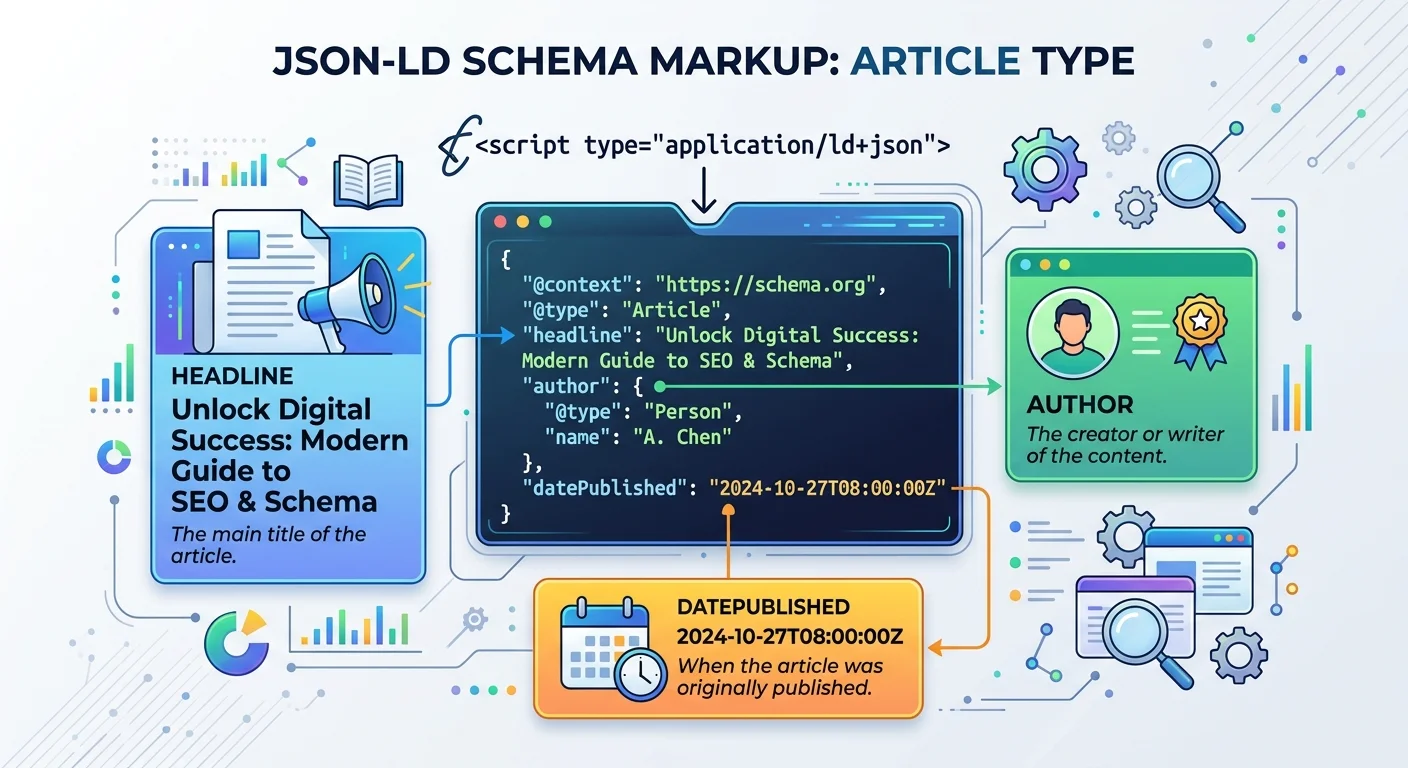
Every page on your site serves a purpose, and your schema should reflect that purpose explicitly. A product page needs Product schema with price, availability, and review data. A blog post needs Article with author, datePublished, and headline. Mismatched schema confuses AI agents and can actually reduce your visibility rather than improve it. Think of schema as a contract: you're telling the agent exactly what kind of content lives on this page.
When you're deciding how to make your website AI agent friendly, schema selection is the first concrete action to take. Agents rely on these type declarations to categorize and rank content. A page marked as FAQPage gets parsed for question-answer pairs, while a generic WebPage type offers the agent almost nothing actionable. Be precise, be specific, and avoid the temptation to mark everything as WebPage just because it's easy.
Use Schema.org's "More specific Types" hierarchy to find the most granular type for each page rather than defaulting to broad categories.
| Schema Type | Best For | AI Agent Value | Priority |
|---|---|---|---|
| Article | Blog posts, news | Content extraction | High |
| FAQPage | Help pages, Q&A | Direct answers | High |
| Product | E-commerce listings | Comparison shopping | High |
| HowTo | Tutorials, guides | Step extraction | Medium |
| Organization | About pages | Entity recognition | Medium |
| BreadcrumbList | All pages | Site structure mapping | Medium |
| Event | Calendars, listings | Time-sensitive data | Low |
Step 2: Implement JSON-LD Correctly
Structure Your JSON-LD Blocks
JSON-LD (JavaScript Object Notation for Linked Data) is the format Google recommends, and it's also what most AI crawlers parse most reliably. Unlike Microdata or RDFa, JSON-LD sits in a <script> tag in your page's <head>, completely separate from your visual HTML. This separation means you can modify structured data without touching your templates. It's cleaner, easier to maintain, and less prone to breaking when designers update the front end.
A basic JSON-LD block for an article looks straightforward, but the details matter. Always include @context set to https://schema.org, the @type, and all required properties for that type. For Article, that means headline, author, datePublished, and image at minimum. Missing required properties don't throw visible errors on your page, but they silently reduce the value of your markup to AI agents that expect complete data objects.
Never duplicate JSON-LD blocks on the same page for the same entity. Multiple conflicting Article schemas confuse both search engines and AI crawlers.
Nest and Connect Entities
The real power of JSON-LD emerges when you nest related entities. An Article can contain an author property that itself is a full Person object, complete with name, URL, and sameAs links to social profiles. This nesting creates a knowledge graph on your page that AI agents can traverse. The difference between AI crawling and traditional crawling often comes down to how deeply agents can follow these entity connections.
Consider adding sameAs properties to your Organization and Person schemas, linking to Wikipedia, LinkedIn, or other authoritative profiles. AI agents use these cross-references to verify entities and build confidence in your data. A well-connected schema graph signals authority. For example, a recipe site that nests NutritionInformation inside its Recipe schema gives agents structured nutritional data they can compare across sources, which dramatically increases the chance of being cited in AI-generated responses.
"Structured data isn't just metadata; it's the language AI agents actually speak when they process your website."
Step 3: Validate and Test Your Markup
Use Multiple Validation Tools
Writing structured data without testing it is like writing code without running it. Google's Rich Results Test and the Schema Markup Validator (formerly the Structured Data Testing Tool) are your two primary validation resources. The Rich Results Test tells you whether your markup qualifies for enhanced search features, while the Schema Markup Validator checks your JSON-LD against the full Schema.org specification. Both catch different issues, so run both every time.
Beyond Google's tools, browser extensions like the Structured Data Inspector can give you quick, page-level validation during development. These tools let you inspect the parsed schema graph directly, seeing exactly what an agent would extract. Pay close attention to warnings, not just errors. A warning about a recommended but optional property (like image on an Article) often represents a missed opportunity that could have given AI agents additional data to work with.
Test Against AI Crawling Behavior
Traditional validation confirms your schema is syntactically correct, but agent-friendly optimization goes further. You need to verify that your structured data is actually accessible to AI crawlers. Some single-page applications render JSON-LD client-side via JavaScript, which older crawlers may not execute. Test your pages using curl or a tool like Puppeteer in non-JavaScript mode to confirm the markup appears in the raw HTML response. If it doesn't, server-side rendering or prerendering is necessary.
A comprehensive technical SEO checklist for AI optimization should include structured data accessibility as a core item. Check that your robots.txt doesn't inadvertently block the JavaScript files needed to render your schema. Also verify that your server responds within reasonable timeframes; AI crawlers often have stricter timeout thresholds than traditional search bots. A slow response means your carefully crafted schema never gets parsed at all.
Some AI agents, including those powering ChatGPT and Perplexity, may cache structured data differently than Googlebot. Test across multiple user-agent strings.
Step 4: Maintain and Expand Over Time
Schedule Regular Schema Audits
Structured data degrades over time. Pages get updated, templates change, CMS plugins get deprecated, and new schema properties become available. Set a quarterly audit schedule to review your structured data across the site. Use a crawling tool like Screaming Frog or Sitebulb to extract all JSON-LD blocks at once, then compare them against current Schema.org documentation. Properties that were recommended last year may now be required, and new types may better describe your evolving content.
Schema drift is particularly common on large sites where different teams manage different sections. An e-commerce team might update product page templates without realizing they've broken the AggregateRating nesting. A content team might add a new blog category that lacks any schema at all. Centralized monitoring, even something as simple as a shared spreadsheet mapping URL patterns to expected schema types, catches these gaps before they compound into serious AI visibility losses.
Add structured data validation to your CI/CD pipeline. Tools like schema-dts (TypeScript definitions for Schema.org) let you type-check your JSON-LD at build time.
Scale with Automation
Manual JSON-LD maintenance doesn't scale past a few dozen pages. For larger sites, build schema generation into your content management workflow. Most modern CMS platforms (WordPress with Yoast or Rank Math, Contentful with custom content models, headless setups with Next.js) support automated JSON-LD injection based on content fields. Map your CMS fields directly to schema properties so that every new page ships with correct structured data from the moment it's published.
For custom applications, consider generating JSON-LD server-side from your database models. If your product database already stores price, SKU, availability, and description, a thin mapping layer can output valid Product schema without any manual effort. The same approach works for Event, JobPosting, and Course types. Automation doesn't just save time; it eliminates the human error that accounts for most schema issues on production websites. Invest in the tooling once, and every future page benefits automatically.

Frequently Asked Questions
?How do I nest related schema types to create richer data graphs?
?Is JSON-LD better than microdata for AI crawler compatibility?
?How often should I audit structured data before schema drift becomes a problem?
?Does using a generic WebPage schema type hurt AI visibility?
Final Thoughts
Structured data is the bridge between your website's content and the AI agents trying to understand it. The four steps above, choosing the right schema types, implementing JSON-LD properly, validating thoroughly, and maintaining over time, form a complete workflow for AI SEO readiness.
None of these steps require exotic tools or massive budgets; they require attention, precision, and consistency. Start with your highest-traffic pages, validate relentlessly, and automate where you can. The websites that invest in agent-friendly structured data today will be the ones AI systems cite tomorrow.
Disclaimer: Portions of this content may have been generated using AI tools to enhance clarity and brevity. While reviewed by a human, independent verification is encouraged.